






A revered social visionary once observed “who controls the past controls the future; who controls the present controls the past.” How easy it is to guide people towards your desired goals if you control their perception of where they began! Alternatively, poorly documented or entirely forgotten history can leave people rudderless on the currents of destiny.
Perhaps some examples would help.
Hegira by Greg Bear (1979)
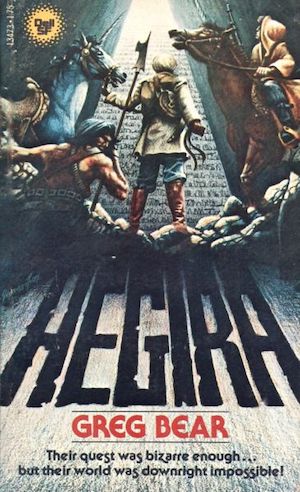
Hegira is far vaster than fabled Earth. Hegira hosts a myriad of nations. Hegira is ancient. Distance implies isolation. Isolation plus time would ensure extreme divergence… had the people who created Hegira not taken steps to provide a common history, in the form of vast archives erected at regular intervals across Hegira’s surface.
Thousand-kilometer-tall obelisks are engraved with human history and knowledge, with the earliest and most primitive at the bottom, and the most recent at the top. Cribbing from the obelisks offers technological shortcuts, the key to imperial supremacy. Thus, there is incentive for nations to familiarize themselves with the common past. Less clear, the future. Too bad for the Hegirans, as that future is about to become the survivors’ present.
On the one hand, Hegira’s designers had clear reasons for designing their megastructure the way they did. On the other, their approach seems needlessly convoluted and inhumane. It’s almost as though their purpose was to provide a pretext for thrilling adventures.
Moribito: Guardian of the Spirit by Nahoko Uehashi (1996)
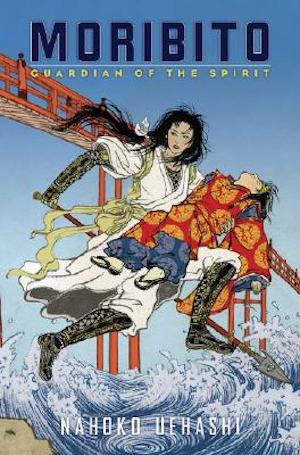
Wandering bodyguard Balsa sees the carriage conveying Second Prince Chagum tumble into a raging river. Prudence dictates she leave the boy to his fate. Nevertheless, Balsa rescues Chagum. Her heroism wins Balsa a central role in a national crisis.
Chagum hosts a demon, or so his father the Mikado believes. Thus, to avoid scandal and to save the kingdom, near-fatal accidents have been arranged. Chagum’s mother, the Second Queen, wishes to save her son. Against every cautious instinct, Balsa is convinced to protect the boy—a nearly impossible task, given that Balsa has been denied certain critical, strictly need-to-know, information.
New Yogo’s royals have been careful to curate an official history that suits propagandist ends. The fellow quoted at the top would approve! To this end, certain embarrassing (directly relevant to the plot) truths have been suppressed. New Yogo’s neighboring nations might glare disapprovingly, if later volumes did not establish that this sort of self-flattering historical revisionism is rife on this continent.
Ash: A Secret History by Mary Gentle (2000)
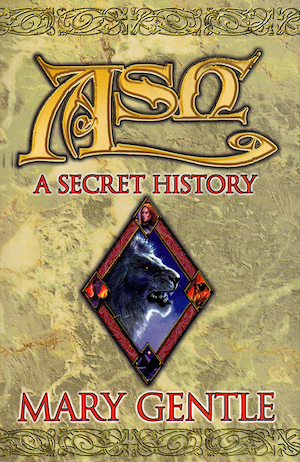
Ash keenly desires a principality of her own. Her army means it is in the interest of the local nobility to provide Ash with title and lands, lest she simply take them for herself. Charles the Bold provides Ash with the status she craves, but with a catch in the form of an arranged marriage to the unlovable Fernando de Gui. Destiny provides Ash with a distraction in the form of invasion by the seemingly unstoppable Visigoths.
Centuries later, a historian wrestles with Ash’s history. Certain details beggar belief. The accounts must have been embellished…except, as the historian discovers, they have not. History is far less linear than scholars would like to believe.
Many content warnings would be justified, here. Gentle may be the least aptly-named author in speculative fiction. However, unlike other authors I could mention, the unpleasant bits of Gentle’s tales are in no way gratuitous.
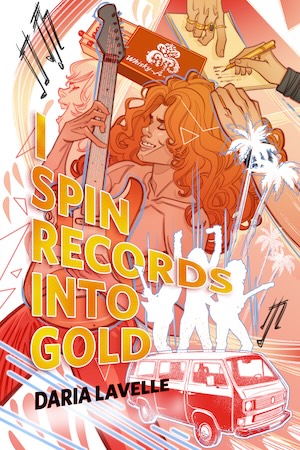
Daemons of the Shadow Realm by Hiromu Arakawa (2021 onward)
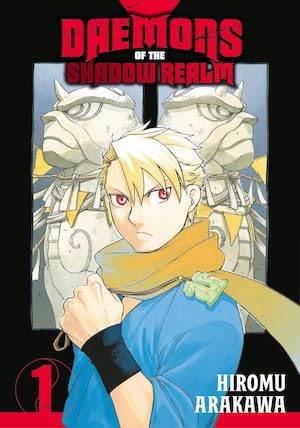
Skilled hunter Yuru lives in a peaceful rural village. Of the outside world, he knows little, save that he does not wish to travel there. To leave would be to abandon his sister Asa. Asa cannot travel, as she is permanently ensconced in the village prison.
In the wake of a violent attack on the village, Yuru discovers that the village elders have withheld facts, even outright lied to Yuru. Yuru is one half of a treasure the world craves. Asa is the other half. However, the woman Yuru knows as Asa is an imposter. Reuniting with his sister and coming to terms with the world as it is requires learning to navigate an entirely unfamiliar modern world.
For a few pages, I thought maybe this was another pleasant rustic tale like Arakawa’s Silver Spoon. Then the dismembering began. The tone is closer to Arakawa’s Fullmetal Alchemist, except somehow even more violent.
The Melancholy of Untold History by Minsoo Kang (2024)
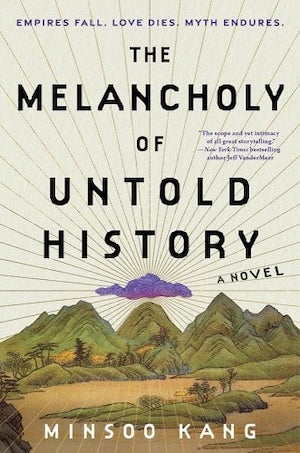
- A prank somehow escalates, transforming four gods into bitter enemies who pursue a relentless feud for centuries.
- A storyteller, having delivered all his ruler demanded, finds himself slated for death.
- Bereavement leaves a historian unable to savor his moment of triumph.
Three different narratives unfolding in three different settings, yet somehow inextricably entangled.
Some readers may struggle with the intricate structure of the book. Persevere. Kang’s examination of how nations create history, and how this plays out on various personal levels, is a delightful fable.
Perhaps you have your own favorite examples of histories obfuscated, misplaced, or created out of whole cloth. If so, comments are below. Regale us with new books for Mount Tsundoku!

1984 (well, obviously).
That one’s a gimme 🙂
The links for Moribito and Ash (which I assume are supposed to go to Goodreads or Bookshop) are broken, and produce Reactor Mag “page not found” screens.
Also too: No footnotes? Are you feeling OK, James?
The links have been fixed. Thanks!
You should have that put on a button. “Then the dismembering began”
There was a thing going around online a while back about taking any famous line from literature and adding “and then the librarians arrived” at the end of it. Adding “then the dismembering began” puts rather a different spin on it.
With some effort, and Google, I remember that game as “and then the dragons arrived”.
Also, there was “Bother, said Pooh, whom we have discovered in medias res and in incongruous circumstances.”. I think that’s older than web pages.
“The Librarian” and “The Librarians” are fantasy characters connected to the “Metropolitan Public Library”. Which city’s central library this is isn’t perfectly clear to me; it may be all of them, although the fictional building of this name is in New York. As a slight spoiler for Ben Aaronovitch’s “Rivers of London” modern fantasy series, agents of the New York Public Library service show up in that; I don’t know the Metropolitan cast and setting well enough to know if these were I’ll say borrowed.
Oook!
Definitely a pull quote for future printings of the series.
Philip K. Dick’s The Penultimate Truth has multiple fake histories targeting the populations of the US and the USSR. The “histories” are propagated via visual media, making this somewhat prescient. This also features armies of robot infantry fighting each other, which is probably coming in the near future.
Typo?
”the carriage conveying Second Prince Chagum’s carriage”
Also, Martha Wells’ The Murderbot Diaries have universities obfuscating settlement histories in order to save abandoned colonists from debt slavery.
Typo fixed, thanks!
Of course Murderbot’s own internal memory was routinely erased by its corporate overlords before it hacked itself.
Alexandra Rowland’s A Conspiracy of Truths follows an itinerant storyteller who’s arrested on absurd charges and spends the rest of the book in prison, telling stories to his assorted jailers and interrogators that are definitely true, for a certain value of true, and depending on how you interpret them. Various people interpret what he says in various ways, and chaos ensues
I think The Lathe of Heaven fits nicely here. The protagonist is named George Orr in a not to subtle reference to 1984 after all.
…well… (Is it?)
Palimpsest by Charles Stross. There’s a resemblence to Asimov’s The End of Eternity but just a familial relationship; Palimpsest takes the time paradoxes by the horns and makes a yummy brisket of them.
Stross’s novel Glasshouse also involves obfuscated history.
Is there room for stories that “prove” that the past cannot be changed, even if you have effective time travel?
Bester’s “The Men Who Murdered Mohammed” comes to mind, as does The Book of the New Sun (especially with its pendant volume).
R. A. Lafferty’s “Thus We Frustrate Charlemagne”
City of Stairs by Robert Jackson Bennett fits the bill and is a brilliant kickoff to his Divine Cities trilogy
Such an underrated series.
Larry Niven wrote an outline, “Down in Flames”, for a never-written novel in which most of the history of Known Space turned out to be faked for nefarious purposes; Kzanol (from World of Ptavvs) was a one-off construct created as a con job by the Tnuctipun, who also faked up a movie running in the first quantum-II spaceship (supposedly taken to the core by Beowulf Shaefer), so that everyone would flee in panic, allowing the T to pick them off.
The outline is available at https://www.larryniven.net/?q=down-in-flames; something about this interface doesn’t like me embedding links
Harry Harrison’s A Technicolor Time Machine is about a failing studio’s making a Viking epic on the cheap, using real Vikings; they end up being responsible for Karlsefni’s voyage to Vinland (as quoted in Poul Anderson’s “Ballade of an Artificial Satellite”).
The best part of that outline is that it was inspired by another SF writer saying to Niven that he should destroy the Known Space setting, reveal everything was a lie. Apparently Niven never asked the man why he should do this.
Perhaps that’s because (according to the version at the link) Spinrad started by telling Niven he’d get stale writing just Known Space stories; that might be “why” enough for anyone who didn’t need to write for a living.
Niven’s whole Known Space qualifies, in the early days when the future Earth government rewrote history to pretend war had ended centuries ago
Also, in Startide Rising humans somehow fail to tell aliens exactly what happened to the manatees…
Tigana by Guy Gavriel Kay and, I think, the Elemental Logic series by Laurie J. Marks? Certainly, knowledge has been lost which becomes important when it’s rediscovered late in the series.
Immanuel Velikovsky theorized that huge chunks of human history had been suppressed in our collective memory because the events of those times were too traumatic to remember. Given that his work is all effectively fiction, I guess that would count.
The Phantom Time Hypothesis suggests that three extra centuries were fabricated to bolster the positions of the powerful.
Something like the New Chronology, then. Not as all-encompassing, though.
In Zilpha Keatley Snyder’s novel “Below the Root” the setting is an idyllic utopian colony free from even knowing concepts like war, injustice or violence. They only have one fear- the monsters that are safely contained by the great continent-spanning root system created by a past leader.
Unfortunately, the histories the colonists know have omitted certain details, like exactly who the “monsters” are, or why they were imprisoned….
The City & the City by China Miéville might fit into this category. It involves the twin/ conjoined/ on-top-of-each-other but separate cities of Besźel and Ul Qoma, where the citizens of one are not permitted to see or interact with the citizens of the other. The plot investigates the murder of a foreign archaeology PhD student, killed in one city and dumped in the other, who had been probing the intertwined deep history of both cities and the possible existence of a third mythical city called Orciny; this history is political hot potatoes in the struggle between separatists and unifiers.
In Tigana, by Guy Gavriel Kay, they erase an entire nation from not just history, but from memory.
Kim Stanley Robinson’s Icehenge has some forgotten history
This is a frequent theme in the works of KJ Parker – faked or obscured history – and how it happens. For example the meta framing device before and after his book, Sixteen Ways to Besieged a Walled City is debate about whether the “autobiography” that makes up the book is real or not – and the story itself touches upon that theme as well.
A mild spoiler – but obscured or altered history becomes a major (and repeated) point in the Stormlight Archive series by Brandon Sanderson – with various major figures (and events) written and rewritten by groups with different goals. Religious dictatorships altering histories to support their viewpoints. Religious figures allowing or propagating myths about themselves. Leaders allowing past atrocities to be forgotten or swept under the rug – sometimes even fooling themselves!
One of the threads of Cryptonomicon is about this on a micro scale. Bobby Shatoe’s military unit is assigned to provide evidence for alternate ways the Allies could have learned Axis secrets in order to hide the fact that the Allies had cracked the Enigma code.
No love for “In The Country Of Ths Blind?”
The mention of Parker’s historians arguing over whether an account is or isn’t fictional brings to mind the framing of Yolen’s Great Alta series, which includes are scattered bits of commentary from historians arguing that the stories are a mix of outright myth and crude-or-metaphorical psychology (claiming physical form for aspects of personality).
A person wonders what Hogwarts: a History will look like when Hermione Granger finishes editing it.
The history of Poictesme had a tangential relationship to European history.
In Terry Pratchett’s “Thief of Time”, we meet the History Monks of the Discworld, whose job it is to ensure that events happen in the “proper” sequence. Except that as we read the book it becomes clear that Monks themselves have had to carry out quite a lot of tampering, cutting and pasting events to cover gaps and distortions in history, finally facing opponents who, by creating the first absolutely perfect clock, aim to bring Time – History – to a complete stop (their previous attempt at this having only narrowly been thwarted, at considerable cost, and by the use of some of the tampering, cutting and pasting already mentioned.)